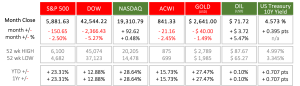
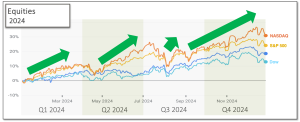
Last year was productive for equity investors, with American indexes delivering remarkable returns for the second consecutive year. The S&P 500 fell just 1 percent behind last year’s stellar results of 24 percent, as did the Dow at nearly 13%, and the NASDAQ more than doubled its 2023 performance in 2024.
The first quarter of 2024 was a steady climb after the first week, a short stumble in April was quickly recovered and a 3-month rise saw a 1-month decline from mid-July until early August. Between a short dip in September and the end of December saw equity values rise steadily and deliver strong results.
Thankfully oil prices ended the year where they began, and energy prices contributed to the overall moderating of inflation increases.
As inflation fell and job creation slowed action was taken by central banks to reduce interest rates to spur economic activity. Tracking inflation, employment and Gross Domestic Product to predict interest rate moves was the theme for analysts and investors in 2024.
Summary of economic events that contributed to market performance in 2024:
January 5th
U.S. nonfarm payroll employment increased 216,000 in December, exceeding analyst expectations. Strong jobs creation, typically, is good-news for equities in the short-term, but may not allow interest rates to fall further propelling the economy and equity values. BLS releaseCNBCCNBC and jobs and rates
January 11th
The U.S. Bureau of Labor Statistics (BLS) released the Consumer Price Index for December, and year-over-year inflation for calendar 2024. Consumer prices rose 0.3% in December, up from 0.1% in November. Over the past 12 months, the all-items index increased 3.4%. BLS CPI release
January 18th
After a short period of tempering related to U.S. employment and inflation data, the S&P 500 set a new all-time closing high, and the Dow bested its previous record. U.S. equities were also assisted by a legislative advance, when the U.S. Congress approved another stop-gap spending bill to keep the federal government operating. These would be the first of many new records set by equity indexes in 2024. WaPo and spending bill
January 19th
The Canadian Consumer Price Index (CPI) rose 3.4% on a year-over-year basis in December 2023, after the same reading sat at 3.1% in November. For the month the CPI fell 0.3% in December, after a 0.1% gain in November. CPI Annual ReviewStatsCan and CPICBC and CPICityNews
January 24th
The Bank of Canada held its policy interest rate, the overnight rate, steady at 5%. “The Governing Council wants to see further and sustained easing in core inflation and continues to focus on the balance between demand and supply in the economy, inflation expectations, wage growth, and corporate pricing behaviour.”BoC release and MPR
January 25th
Based on Gross Domestic Product, the American economy grew faster than expected and inflation cooled, according to the Bureau of Economic Analysis. In the fourth quarter GDP increased at a 3.3% annualized rate, and the rate of economic growth for the entire year of 2023 was 2.5%.
The Personal Consumption and Expenditure (PCE) price index, which is the Federal Reserve’s primary inflation measurement, rose 0.2% in December and 2.9% for 2023. Including food and energy headline inflation rose 2.6% annually at the end of December. The annualized rate of inflation is approaching the Fed’s low-term average goal of 2%. BEA GDP releaseCNBC and GDPBEA PCE releaseCNBC and PCE
January 31st
In one of their shortest written statements, the Fed communicated “Recent indicators suggest that economic activity has been expanding at a solid pace. Job gains have moderated since early last year but remain strong, and the unemployment rate has remained low. Inflation has eased over the past year but remains elevated.” The statement suggested that the Federal Reserve’s interest rate committee, the FOMC, believes that the U.S. economy is performing well enough that it did not need monetary policy stimulus at that time, and monetary policy stimulus would add to a higher than desired rate of inflation. Fed release and presser
February 2nd
The U.S. economy’s ability to add jobs proved to be remarkably resilient. Total nonfarm payroll employment rose by 353,000 in January, the largest monthly increase since January 2023. Lower job creation would support the Federal Reserve lowering interest rates, but on its own merits, the robust employment situation is positive for the economy. BLS releaseCNBC and jobs
February 9th
The S&P 500 breached and closed over 5,000 points for the first time in its history. After closing over 4,000 points in April 2021, it took almost three years to reach the next millennium. Much of the U.S. gains were attributed to the growing sentiment that the Federal Reserve achieved a soft landing by slowing inflation, and not placing the economy into a recession.
February 13th
U.S. inflation was more persistent than expected. Continuing inflation above goal lessened the likelihood of a Federal Reserve rate cut. Year-over-year inflation remained above goal at 3.1%. On a monthly basis, prices rose 0.3% in January, higher than the 0.2% seen in December. BLS CPI releaseCNBC CPI and rates
February 16th
The Producer Price Index, that tracks the prices domestic producers receive for their output from customers who are not end-consumers. It provides a measure of insight into future consumer price levels as producer prices move through the supply chain toward end-buyers. The PPI rose 0.3% in January after declining 0.1% in December. The increase was small, but a price increase does not support falling interest rates. BLS PPI releaseCNBC and PPI
February 21st
The Federal Reserve released the minutes of its latest interest rate meeting that showed concern that progress against inflation could stall. The areas of concern were consumer spending and business hiring. The minutes included, “participants judged that the policy rate was likely at its peak for this tightening cycle.” The timing of interest rate reductions remained uncertain despite the progress against inflation. FOMC MinutesCNBC and FOMC Minutes
February 22nd
The NASDAQ jumped 3%, largely driven Nvidia, the computer chip manufacturer at the forefront of the artificial intelligence industry. Nvidia released an optimistic forecast of earnings that projected a threefold increase in quarterly revenue. Its fourth quarter revenue was $22.1 Billion, a 265% increase from Q4 2022. Nvidia’s share price jumped 11% on the day, and its value breached $2 Trillion and pulled the NASDAQ along with it. CNBC and Nvidia
The Canadian Consumer Price Index rose 2.9% on a year-over-year basis, down from 3.4% in December. Excluding gasoline, consumer prices rose 3.2% last month. Mortgage interest costs were the largest driver of inflation increasing at an annual rate of 27.4%. CPI releaseCBC and inflation
February 29th
The U.S. Personal Consumption Expenditures price index rose 2.4% in January, and core PCE (excluding food and energy) rose 2.8% on a year-over-year basis, and 0.4% in January. These levels were aligned with analyst expectations. PCE and CNBCBEA's PCE
March 6th
The Bank of Canada held its policy interest rate unchanged. “The Bank continues to expect inflation to remain close to 3% during the first half of this year before gradually easing”. Tiff Macklem, Bank of Canada Governor stated, “We don’t want inflation to get stuck, materially, above our target.” BoC releaseCBC and BoC
March 7th
The European Central Bank (ECB) mirrored the Bank of Canada’s decision to keep policy interest rates unchanged. ECB staff project “inflation to average 2.3% in 2024, 2.0% in 2025 and 1.9% in 2026.” ECB release
March 8th
The U.S. economy added 275,000jobs, above the average monthly gain of 230,000 over that last year. The unemployment rate rose 0.2% to 3.9% as 334,000 more job seekers were unsuccessful and total 6.5 million, up 500,000 over February 2023. BLS releaseCNBC and jobs
March 12th
The Bureau of Labor Statistics reported that the U.S. Consumer Price Index rose 0.4% in February, up from January’s 0.3% rise. On a year-over-year basis consumer prices increased 3.2%. Shelter and gasoline contributed more than 60% of February’s one-month price inflation. BLS CPI release
March 19th
The Canadian Consumer Price Index rose 2.8% on a year-over-year basis in February, down from 2.9% in January. The slowing of inflation was positive news for consumers and borrowers. StatsCan releaseCBC and BoC
March 20th
The Federal Reserve kept its rates unchanged. The Fed released its quarterly Summary of Economic Projections (SEP) that indicated interest rates are expected to be lowered in 2024, 2025 and 2026. Fed release, SEP, and press conf
April 5th
Canadian and American job announcements demonstrated two differing economic directions. The strength or weakness of employment will contribute to upcoming interest rate announcements in each country.
Canadian employment fell by 2,000 jobs in March and the unemployment rate rose 0.3% to 6.1%. Since last year the Canadian unemployment rate has risen 1 percent as the number of unsuccessful job seekers has grown by approximately 60,000 over the past twelve months. StatsCan Labour Force Survey
In the U.S. total nonfarm payroll employment rose by 303,000 in March. It was the 39th consecutive month of rising employment. The unemployment rate sat at 3.8% and changed little since last month as 6.4 million workers attempted to find jobs. BLS Nonfarm Payroll Report
April 10th
The Bank of Canada held its policy interest rates unchanged. Canada was ahead of the U.S. in lowering domestic inflation, cooling the economy and employment, and “economists have forecast that the Bank of Canada will lead the U.S. Federal Reserve in rate cuts as economic data in both countries have been diverging.” BoC releaseCBC
U.S. consumer prices increased 0.4% in March, the same increase that was reported one month ago for February. Over the past 12 months, the all-items index increased 3.5% in March, higher than the 3.2% recorded for February. BLS CPI release
April 25th
The latest real Gross Domestic Product data from the Bureau of Economic Analysis (BEA) showed that annualized economic growth has slowed to 1.6% in Q1 2024, down from 3.4% and 4.9% in Q4 and Q3 of 2023, respectively. Slowing GDP growth relieved pressure to maintain current interest rates. BEA releaseCNBC and GDP
April 26th
The Personal Consumption Expenditures price index fulfilled predictions. Jerome Powell, Fed Chair, stated that U.S. consumer inflation is reluctant to return to pre-pandemic levels despite the elevated levels of interest rates. Inflation arose due to a shortage of supply, which drove prices higher. As supply chain issues resolved and inflation persisted, central banks increased interest rates designed to curtail demand, and inflation, back to low and predictable levels. For March, U.S. PCE inflation was 2.7% year-over-year, compared with January and February’s 2.5%. All three months are above the Fed’s goal of an average of 2%. BEA PCE releaseCNBC and PCE
April 30th into May 1st
April transitioned into May with a Federal Reserve interest rate announcement. Markets awaited confirmation that the Federal Reserve would keep interest rates unchanged, and the Fed did not disappoint analysts. The federal funds rate will stay in the range of 5¼ to 5½ percent. Fed releaseFed Press ConfCNBC and Fed rates
May 3rd
The non-farm payroll report from the U.S. Bureau of Labor Statistics showed that employment had increased by 175,000 in April, which was below expectations. Dow Jones consensus predicted 240,000 jobs. The unemployment rate ticked up 0.1% since March to reach 3.9%. After the jobs report, markets priced-in a strong chance of two interest rate cuts by the Federal Reserve before the end of 2024. BLS releaseCNBC and Non-Farm Payrolls
May 15th
In April, the U.S. Consumer Price Index ticked downward to 3.4% on a year-over-year basis. The inflation news provided positive energy to major indexes following the announcement the S&P 500 jumped 1.2%, the Dow rose 1.4% and the NASDAQ moved 0.9% higher. The S&P 500 and NASDAQ each touched new record highs, with all three indexes achieving new record closing levels. BLS releaseCNBC stocksCPI and rate cuts
May 24th
The S&P 500 earnings season neared its completion as 96% of companies having reported results, and 78% delivered a positive earnings surprise, and 61% achieved a positive revenue surprise. FactSet Q1.
May 31st
The U.S. Personal Consumption Expenditures price index rose 0.2% in April and was unchanged on a year-over-year basis compared to March at 2.7% and remained above the 2.5% level seen in both January and February. BEA PCE releaseCNBC and PCE
June 7th
U.S. jobs market continued its strong growth when nonfarm payroll increased by 272,000 in May, unemployment remained unchanged at 4.0 percent with 6.6 million unemployed people. One year ago the unemployment rate was 3.7 percent and 6.1 million unemployed people. BLS release
June 12th
The Bureau of Labor Statistics re-released U.S. inflation data for May that showed consumer prices were unchanged in May and the year-over-year rate of consumer inflation was 3.3%. The U.S. Federal Reserve held interest rates unchanged. FOMC and rate information
In the U.S., “Total nonfarm payroll employment increased by 206,000 in June, and the unemployment rate changed little at 4.1 percent according to the Employment Situation Summary. Early reports suggest that the jobs report “could support the idea that [the Fed] will cut relatively soon” according to Goldman Sach’s chief economist. CNBC and nonfarm payrolls
July 11th
U.S. Consumer Price Index (CPI) declined by 0.1% in June, as gasoline prices fell and food prices rose, just as they did in May. Over the last 12 months consumer prices have risen 3.0%, down 0.3% from May’s 3.3%. This is the lowest level for the CPI in more than three years, and far below its peak of more than 9% experienced in June 2022. BLS CPI releaseCNBC and CPI
July 15th
A massive computer outage caused by a software upgrade by cyber security company, CrowdStrike, disrupted capital markets in addition to fouling transportation networks. The tech-heavy NASDAQ lost 3½ percent during the third week of the month after six weeks of gains.
July 24th
The Bank of Canada lowered its overnight rate by ¼ percent (25 basis points) to a target of 4.5 percent, and released its latest Monetary Policy Report. According to the Bank of Canada announcement, “The Bank’s preferred measures of core inflation are expected to slow to about 2½% in the second half of 2024 and ease gradually through 2025.”
July 26th
The U.S. Federal Reserve’s preferred inflation measure, the Personal Consumption Expenditures (PCE) price index, showed that prices have risen 2.5% on a year-over-year basis. Core PCE, which excludes more volatile food and energy, increased 2.6% since last year. Both are above the Fed’s 2% target for long-range inflation. PCE releaseCNBC and June PCE
July 31st
As expected, the U.S. Federal Reserve held rates unchanged in their FOMC statement. However, during the following press conference , Fed Chair, Jerome Powell, indicated that a rate cut in mid-September was “on the table”, providing a boost on the last afternoon of the month. CNBC and Fed
August 2nd
Job creation is slowing, and unemployment is rising according to the monthly report from the U.S. Bureau of Labor Statistics (BLS). Employment edged up by 114,000, which is about half the monthly average of 203,000 for 2024. CNBC and jobs
August 5th – 8th
Corporate earnings are not the issue according to FactSet's Earnings Insight for the S&P 500. With 91% of companies reporting, more than three-quarters of them have delivered a positive earnings surprise and more than half have delivered a positive revenue surprise. Also, the blended year-over-year earnings growth rate is 10.8%. If this level is maintained after all S&P 500 companies have reported, it will be the highest growth rate for earnings since 2021.
August 14th
“The Consumer Price Index for All Urban Consumers (CPI-U) increased 0.2 on a seasonally adjusted basis, after declining 0.1 percent in June. Over the last 12 months, the all-items index increased 2.9 percent before seasonal adjustment” according to the release from the Bureau of Labor Statistics. Nearly 90 percent of the monthly increase has been attributed to the index for shelter, which rose 0.4 percent in July.
August 30th
U.S. GDP grew at an 3.0% annualized rate in the second quarter. It was an upward revision from 2.8% reported last month, and more than double the 1.4% reported in the first quarter. Based on the improving economic activity the likelihood of a Federal Reserve rate cut of ½ percent fell, as did the expectation for a recession. CNBC and GDP
U.S. inflation measured by core Personal Consumption Expenditures (PCE) price index increased 0.2% in July and 2.6% from a year ago. Core PCE excludes relatively more volatile food and energy. BEA PCE releaseCNBC and PCE
September 4th
The Bank of Canada announced its third consecutive monetary policy update that reduced the overnight rate by ¼ percent (25 basis points). The target has been reduced from its July 2023 peak of 5 percent to 4 ¼ percent. BoC rate announcementCBC and BoC
September 6th
The Non-farm Payroll Report from the U.S. Bureau of Labor Statistics (BLS) showed employment increased by 142,000 in August, up from 89,000 in July, but below the consensus forecast of 161,000. The U.S. employment situation cleared the Federal Reserve to cut rates. BLS releaseCNBC and jobsCNN, jobs, rates, markets
September 11th
The all-items Consumer Price Index had increased 2.5 percent on a year-over-year basis. The increase was the smallest since February 2021, three and one-half years ago. In August, the prices for shelter (+0.5 percent), food away from home (+0.3 percent) increased, while the index for energy (-0.8) fell. BLS CPI release
September 18th
Following the Bank of Canada’s lead over the summer and on September 4th, the U.S. Federal Reserve slashed the federal funds rate by ½ percent to a range of 4¾ to 5 percent. It was the first rate cut since March 2020. Fed release
The larger-than-usual rate cut suggests that the Fed has started is attempting to ensure a soft landing by avoiding a recession, and more rate reductions can be expected. CNBC and recession
As stated at the Fed's press conference , it appears that rates may be reduced again before the end of 2024, and another 1 percent in 2025 based on the Fed’s Summary of Economic Projections. The long-term expectation is that the policy rate will settle at 2¾ to 3 percent.
September 27th
Before North American markets opened, the U.S. Bureau of Economic Analysis released the latest inflation data. The PCE price index has rose 0.1 percent in August, and 2.2 percent on a year-over-year basis, down from 2.5 percent in July. It is the lowest annualized inflation rate since February 2021. The PCE is the Federal Reserve’s preferred inflation measure and suggests that the Fed will focus on its other mandate to maximize employment. BEA PCE releaseCNBC and PCE
October 4th
The U.S. Bureau of Labor Statistics released September’s nonfarm payroll report showing that 254,000 jobs were added, much higher than the 254,000 in September. In September 6.3 million people were unemployed. The unemployment rate in September was essentially unchanged at 4.1% compared with 4.2% in August. CNBC and nonfarm payrollsBLS release
October 9th
The Federal Reserve released the meeting minutes from their last Federal Open Market Committee (FOMC) interest rate decision on September 18. Committee members were divided between ¼ and ½ reduction, with the larger cut ultimately carrying the vote, 11-1. Recent jobs data suggests that a more gradual approach may have been appropriate. FOMC minutesCNBC and FOMC
October 10th
According to the U.S. Bureau of Labor Statistics, the Consumer Price Index rose 0.2 percent for the month in September. On a year-over-year basis prices have risen 2.4 percent, down slightly from August’s annualized reading of 2.5 percent. In September, the index for shelter rose 0.2 percent, and food increased 0.4 percent. Together these two indexes contributed over 75 percent of the monthly increase. BLS CPI releaseCNBC and CPI
October 15th
StatsCan announced the Consumer Price Index rose 1.6% on a year-over-year basis in September, down from 2.0% in August. It was the smallest yearly increase since February 2021. Gasoline fell by over than 10% in September and was the major contributor to inflation’s deceleration. The price of groceries rose 2.4% in September, the same growth rate as August. The lowering inflation rate encourages the Bank of Canada to continue reducing its policy interest rate. StatsCan CPI releaseCBC and CPI
October 23rd
The Bank of Canada cut its policy rate another ½ percent (50 basis points). After three ¼ point cuts and this ½ point cut, the overnight rate has been lowered to 3.75 percent from its peak of 5 percent. The rate cuts have contributed to the lowering of year-over-year inflation, which sits at 1.6% according to the recent StatsCan release.
October 31st
The U.S. Personal Consumption Expenditures (PCE) price index dropped 0.2 percent to 2.1 percent on a year-over-year basis in September compared with August. Core PCE, which excludes food and energy, was 2.7 percent year-over-year, maintaining the same level for the past three months. BEA PCE releaseCNBC and PCE
November 1st
U.S. employment (+12,000) and unemployment at 4.1 percent were unchanged in October according to the nonfarm payroll report. The low jobs increase, and election uncertainty created a dip for equities to start November. BLS Nonfarm Payrolls release
November 5th to 8th
A decisive election win was the best result for equity investors. A Republican-controlled Senate and House will facilitate the confirmation of federal appointees and the passing of laws. President-elect Trump has promised an extension to his 2017 corporate tax reductions, increased government spending and decreased regulation, which encourage positive corporate results and increased values. NBC News and marketsGlobal and election resultsCNBC on elections and markets
November 7th
The Federal Reserve lowered its policy interest rate by ¼ percent (25 basis points). The release included “In support of its goals, the Committee decided to lower the target range for the federal funds rate by 1/4 percentage point to 4-1/2 to 4-3/4 percent. In considering additional adjustments to the target range for the federal funds rate, the Committee will carefully assess incoming data, the evolving outlook, and the balance of risks.”Fed release
November 13th
Markets settled downward after the large gains of the previous week that had been driven by certainty of U.S. election victories. Once the election results were decided, markets refocused on corporate performance and overall economic conditions to drive markets. CNBC election and valuation
Before markets opened, the U.S. Consumer Price Index for October was reported. For the fourth consecutive month CPI increased 0.2 percent on a monthly basis. On a year-over-year basis consumer prices have increased 2.6 percent. BLS CPI release
The inflation results suggested that the Fed may slow the pace and size of rate cuts as inflation moved upward. Tariff promises made by President-elect Trump would raise inflation, which would also delay rate cuts further into the future. CNBC and CPI (2)
November 22nd
Strong corporate results spurred equities along as earnings season drew to a close. After 95 percent of the S&P 500 had reported their Q3 results, three-quarters of the companies reported a positive Earnings Per Share (EPS) surprise, and nearly two-thirds reported a positive revenue surprise. FactSet Earnings Insight
November 27th
Prices rose 0.2% in October and 2.3% on a year-over-year basis according to the Personal Consumption Expenditures price index. The annualized inflation rate met expectations. BEA PCE releaseCNBC and PCE
December 6th
Canadian employment increased by 51,000 in November following little change in October, according to the Labour Force Survey. The unemployment rate rose 0.3% to 6.8% indicating an increase in job seekers. The unemployment rate has risen 2 percentage points since July 2022. CBC and LFS
The U.S. nonfarm payroll report showed employment rose 227,000 in November and the unemployment rate was unchanged at 4.2%. Job creation was above expectations and October’s flat report. Since last November the number of unemployed persons has risen by nearly 1 million to 7.1 million from 6.3 million when the unemployment rate was 3.7 percent, which was a historically low level. BLS releaseCNBC and payrolls
December 11th
The U.S. Consumer Price Index increased 0.3 percent in November, after four consecutive monthly rises of 0.2 percent. The “all items index” rose 2.7 over the last 12 months before seasonal adjustment. BLS CPI release
The Bank of Canada reduced its policy interest rate by ½ percent (50 basis points) to 3¼ percent. This is the fifth consecutive rate reduction since June. Canadian inflation has been around the Bank’s 2% target. The possibility that the incoming U.S. administration will impose new tariffs on Canadian exports to the U.S. has increased uncertainty and clouded the economic outlook. Nonetheless, current economic performance warranted the rate reduction as explained in the press conference after the release. CBC and Boc rates
December 18th
Major economic news came from the U.S. Federal Reserve on Wednesday, and the effect was negative. American equity indexes fell between 3 and 4 percent following the Fed’s interest rate announcement. At the end of Wednesday the Dow had fallen for the tenth consecutive day, losing more than 6 percent over the period before generating a small gain on Thursday. A rally for equity indexes on Friday limited the losses for the week to about half of Wednesday’s drop.
After concluding that “Recent indicators suggest that economic activity has continued to expand at a solid pace. Since earlier in the year, labor [sic] market conditions have generally eased, and the unemployment rate has moved up but remains low. Inflation has made progress toward the Committee's 2 percent objective but remains somewhat elevated” the target for the federal funds rate was lowered by ¼ percent to a range of 4¼ to 4½ percent.
Lower interest rates typically spur economic expansion and push equity values higher. However, the Fed indicated that it would likely lower interest rates only twice in 2025 according to its Summary of Economic Projections, not four times, as it had previously indicated in September. The slowing of interest rate reductions carried negative sentiment through to the end of the year for equity indexes. Fed announcementCNBC and rates.
Whoops – your free tools have expired. You have reached your download limit. Please upgrade your membership to Advisor Member, or request a Guided Tour to find out more about all the tools and services available! Or continue browsing the Resource Centre.